How Music Education Improves Children's Cognitive Development: The Science Behind the Mozart Effect and Beyond
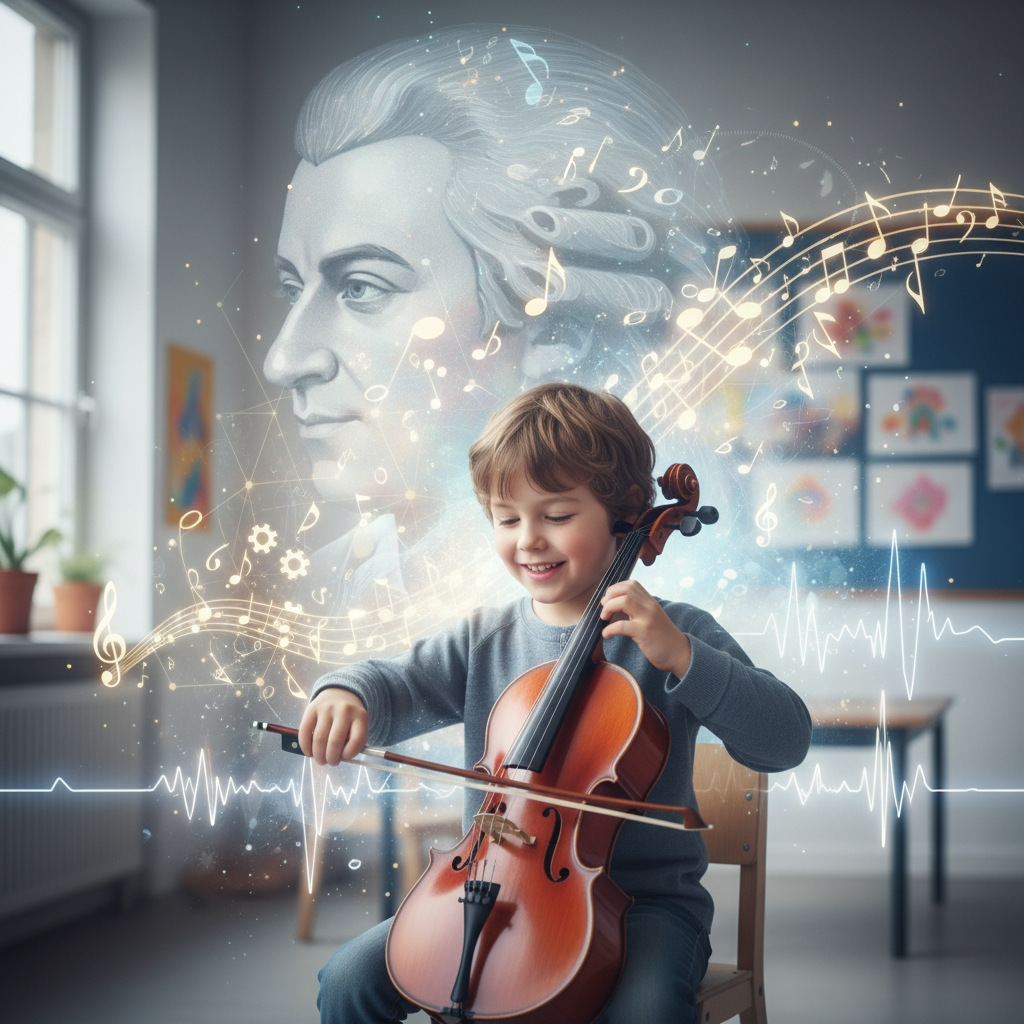
The connection between music education and children's cognitive development is one of the most robust findings in developmental psychology. Far beyond simply learning to play an instrument, musical training reshapes the developing brain in ways that enhance language processing, mathematical reasoning, memory, and even emotional regulation. A comprehensive review by the National Association for Music Education found that children who participate in structured music education outperform their non-musical peers across virtually every academic domain measured.
The Neuroscience of Music and the Developing Brain
When a child plays a musical instrument, their brain lights up like a fireworks show. Neuroscientists at the Brain and Creativity Institute at the University of Southern California used functional MRI imaging in a groundbreaking 2024 study to demonstrate that musical training activates and strengthens neural networks spanning the auditory cortex, motor cortex, prefrontal cortex, and corpus callosum simultaneously. No other single childhood activity engages as many brain regions at once.
Dr. Nina Kraus, a neuroscientist at Northwestern University whose lab has spent over two decades studying music and the brain, explains: "Playing music is the brain's equivalent of a full-body workout. It simultaneously strengthens neural pathways for sound processing, motor coordination, memory, attention, and emotional processing. These are not separate benefits; they compound and reinforce each other."
A 2025 longitudinal study published in the Journal of Neuroscience followed 400 children from age five to fifteen and found that those who received at least two years of consistent music instruction showed measurably greater cortical thickness in brain regions associated with executive function and auditory processing, differences that persisted even if they stopped playing.
Music and Language Development
The overlap between music processing and language processing in the brain is so significant that researchers now refer to them as "shared neural resources." A 2024 meta-analysis in Developmental Science examined 35 studies and found that musically trained children showed:
- 34% better phonological awareness (the ability to detect and manipulate sounds in language)
- 25% stronger vocabulary acquisition
- 20% superior reading comprehension scores
This connection is particularly powerful for children learning to read. The rhythmic and tonal patterns in music map directly onto the prosodic patterns of speech. According to research by Dr. Aniruddh Patel at Tufts University, the precision with which children can perceive musical rhythm directly predicts their ability to perceive the rhythmic patterns of speech, which is foundational to reading fluency.
For children learning a second language, music education provides an even greater advantage. A 2025 study at the University of Toronto found that bilingual children with musical training acquired their second language 40% faster than bilingual children without musical training.
Mathematical Thinking and Musical Training
The link between music and mathematics has been observed for centuries, and modern neuroscience confirms the connection. Music is inherently mathematical: rhythm involves fractions and ratios, scales involve patterns and intervals, and reading music requires spatial-temporal reasoning. A 2024 study in Educational Psychology Review found that children who received structured music instruction for at least one year showed significant improvements in:
- Pattern recognition (28% improvement)
- Spatial-temporal reasoning (21% improvement)
- Proportional reasoning, crucial for understanding fractions (19% improvement)
Dr. Martin Gardiner, a researcher at Brown University, conducted a controlled study where first-graders received either standard arts instruction or enhanced music and visual arts training. After seven months, the musically trained group had caught up to and surpassed their grade level in math, despite having started behind. Gardiner attributes this to "the sequential, pattern-based thinking that music naturally develops."
Memory, Attention, and Executive Function
Learning music places extraordinary demands on working memory. A child playing piano must simultaneously read notation, coordinate both hands with different fingering patterns, maintain rhythm, listen to the sound they are producing, and plan ahead to the next passage. This multi-tasking develops what neuroscientists call executive function, the set of cognitive skills that manage attention, working memory, and cognitive flexibility.
A 2025 study published in PLOS ONE tested executive function in 600 children and found that those with at least two years of musical training outperformed their peers by a statistically significant margin on every executive function measure tested, including the Stroop task, the Wisconsin Card Sorting Test, and backward digit span tasks. The researchers noted that the benefits scaled with the amount of training: more years of music instruction correlated with stronger executive function.
Importantly, these benefits extend beyond music. Children with stronger executive function show better academic performance across all subjects, improved behavioral regulation, and greater social competence. According to Harvard's Center on the Developing Child, executive function skills are "more important for school readiness than IQ."
Emotional Intelligence and Social Skills
Music education does not only sharpen the intellect; it also develops emotional and social capacities. A 2024 study in Psychology of Music found that children who participated in group music-making activities showed:
- Greater empathy, as measured by standardized assessments
- Improved cooperation and teamwork skills
- Stronger emotional regulation abilities
- Higher self-esteem and sense of accomplishment
Dr. Daniel Levitin, a neuroscientist and author of This Is Your Brain on Music, explains that "making music together releases oxytocin, the bonding hormone. Children who play in ensembles learn to listen, synchronize, and contribute to something larger than themselves. These are social skills that transfer directly to every other area of life."
Getting Started: Practical Advice for Parents
You do not need to enroll your child in Juilliard to reap the cognitive benefits of music education. Here is an evidence-based timeline for musical development:
- Birth to 2 years: Sing to your baby, play diverse genres of music, and encourage rhythmic movement. Research shows that musically enriched environments accelerate auditory development even in infancy.
- Ages 2-4: Introduce simple rhythm instruments like shakers, drums, and xylophones. Group music classes such as Kindermusik or Music Together provide structured musical play in a social setting.
- Ages 4-6: Consider formal instruction on a starter instrument. Piano and violin are common choices because they teach music reading and develop fine motor skills. The Suzuki method, which emphasizes learning by ear before reading notation, is particularly effective for young beginners.
- Ages 6+: If your child shows interest, expand to additional instruments, music theory, or ensemble participation. School band and orchestra programs offer structured learning along with the social benefits of group performance.
The key is consistency over intensity. Dr. Kraus's research shows that 30 to 45 minutes of practice three to four times per week produces significant cognitive benefits, and the improvements are cumulative over time. Choose an instrument your child is excited about, find a patient and encouraging teacher, and support regular practice without making it a chore. The goal is to foster a lifelong relationship with music, not to produce a virtuoso. The cognitive benefits are simply a remarkable bonus of an activity that also brings joy, self-expression, and connection to others.
Written by
You might also like
 81
81
Best Creative Craft Kits for Kids: Art Projects They'll Actually Finish
Discover the best creative craft kits for kids that they will actually finish. From sculpting and glass painti...
Our Favorite Ways to Bring Love, Peace, and Whimsy Into Your Child's World
From imaginative play sets to calming mindfulness tools, these are our favorite picks that bring love, peace,...
Our Favorite Bring Your Love, Peace, and Whimsy! Toys and Gifts for Kids
Discover 8 whimsical toys and gifts that bring love, peace, and creative wonder into your child's world while...