How to Identify Your Child's Learning Style: Visual, Auditory, or Kinesthetic
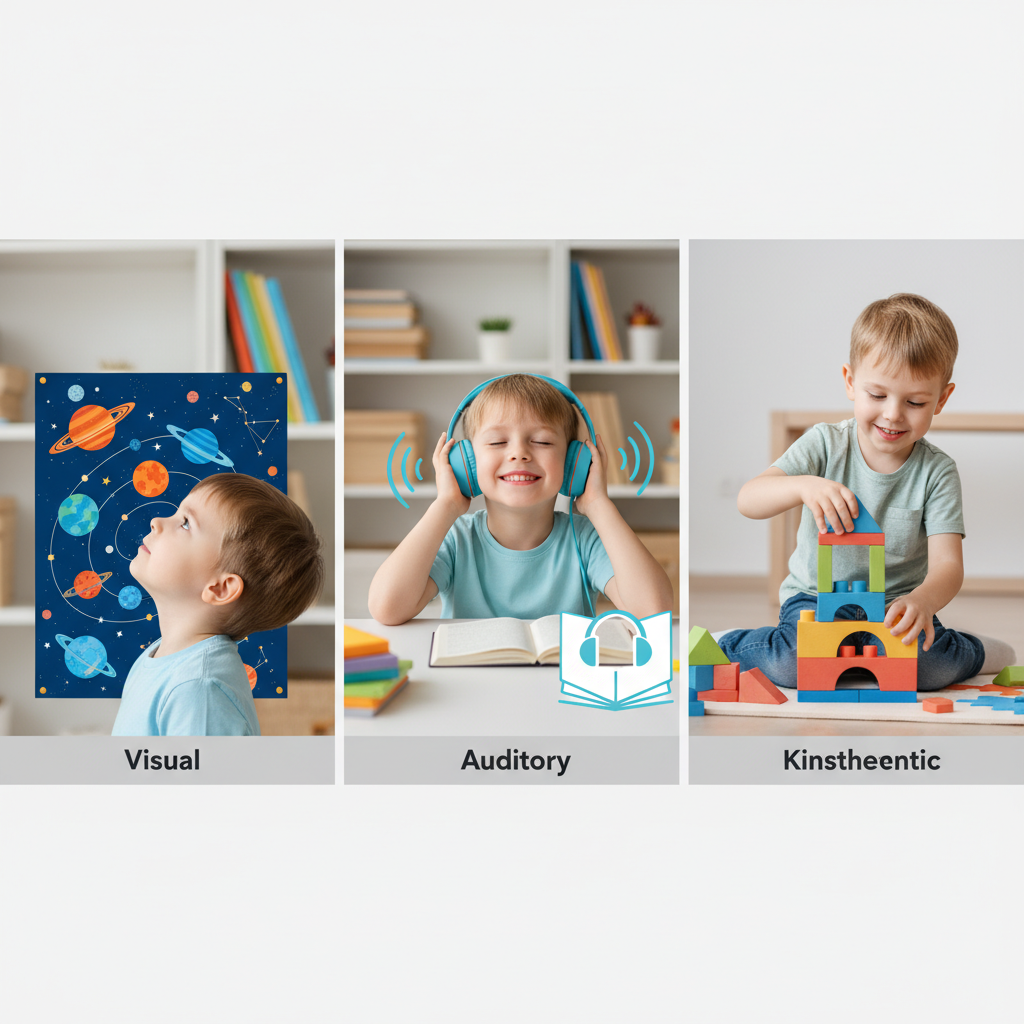
Every child absorbs information differently, and understanding your child's learning style can transform their educational experience. Whether your child is a visual, auditory, or kinesthetic learner, identifying their preferred mode of learning helps you tailor activities, choose appropriate toys, and communicate with teachers more effectively. Research from the National Institutes of Health suggests that learning-style-aligned instruction can improve retention by up to 30 percent in young children.
The Three Primary Learning Styles
Visual Learners
Visual learners process information best through images, diagrams, charts, and spatial understanding. These children tend to think in pictures and may close their eyes to recall information. According to Dr. Linda Silverman of the Gifted Development Center, approximately 30 percent of children are strongly visual learners.
Signs your child is a visual learner: They remember faces better than names. They prefer illustrated books over being read to. They often draw or doodle while listening. They are good at puzzles and spatial games. They say things like "I see what you mean" or "Show me."
How to support visual learners: Use color-coded materials for organizing schoolwork. Provide graphic organizers and mind maps for studying. Choose educational toys with strong visual components like building blocks, art supplies, and anatomy models. Allow them to watch demonstrations before attempting tasks themselves.
Auditory Learners
Auditory learners excel when information is presented through sound, speech, and verbal explanation. They often talk through problems, enjoy discussions, and remember songs and stories with ease. Dr. Prashant Patel of the Learning Sciences Institute estimates that roughly 25 percent of children are primarily auditory learners.
Signs your child is an auditory learner: They enjoy being read to and can retell stories in detail. They hum, sing, or talk to themselves while working. They follow verbal instructions easily but may struggle with written ones. They enjoy group discussions and explaining things to others. They say things like "That sounds right" or "Tell me again."
How to support auditory learners: Read aloud together regularly, even beyond the typical read-aloud age. Use songs and rhymes to teach concepts like multiplication tables. Encourage them to explain what they have learned in their own words. Provide audiobooks and educational podcasts. Allow verbal processing time before requiring written responses.
Kinesthetic Learners
Kinesthetic learners understand the world through touch, movement, and hands-on experience. They learn by doing rather than watching or listening. The International Journal of Educational Research reports that kinesthetic learners represent approximately 35 to 40 percent of children, making this the most common learning style.
Signs your child is a kinesthetic learner: They cannot sit still for extended periods. They touch everything and learn through manipulation. They excel at sports, dance, or building activities. They remember experiences and field trips better than lectures. They use hand gestures while talking and say things like "It doesn't feel right."
How to support kinesthetic learners: Incorporate movement into learning. Let them walk while reciting facts or use a standing desk. Provide manipulatives like math counters, letter tiles, and building materials. Choose educational toys that require physical interaction such as science kits, balance toys, and construction sets. Allow fidgeting during focus tasks as it often helps rather than hinders concentration.
Most Children Are Multimodal
While understanding learning styles is valuable, Dr. Howard Gardner's research on multiple intelligences reminds us that most children use a combination of learning modalities. Rather than labeling your child as strictly one type, observe which modes they gravitate toward naturally and provide a rich variety of learning experiences. The goal is not to restrict but to ensure their strongest channels are adequately supported.
Practical Steps to Identify Your Child's Style
Observe your child during free play. Do they gravitate toward drawing (visual), storytelling (auditory), or building (kinesthetic)? Notice how they solve problems. Do they draw diagrams, talk through solutions, or physically manipulate objects? Ask their teachers for observations about classroom behavior. Try teaching the same concept three ways and notice which approach produces the most engagement and retention.
Working with Schools
Once you have identified your child's learning preferences, share this information with their teachers. Many educators welcome parent insights about learning styles and can adapt their teaching to include more visual aids, discussion opportunities, or hands-on activities. A collaborative approach between home and school creates consistency that reinforces learning.
Frequently Asked Questions
Can a child's learning style change over time?
Yes, learning preferences can evolve as the brain develops. A child who is strongly kinesthetic at age 4 may develop stronger visual processing by age 8. Regular observation helps you stay attuned to these shifts.
Is one learning style better than others?
No learning style is superior. Each has strengths in different contexts. Visual learners may excel in geometry while auditory learners thrive in language arts. The goal is to leverage strengths while gradually building comfort in less preferred modes.
Should I only teach to my child's dominant style?
No. While prioritizing their preferred style reduces frustration and improves engagement, exposure to all modalities strengthens overall cognitive flexibility. Aim for a mix with emphasis on their natural preferences.
How early can I identify my child's learning style?
Observable preferences often emerge around age 2 to 3, but patterns become clearer between ages 4 and 6 when children engage in more structured learning activities.
Written by
You might also like
 81
81
Best Creative Craft Kits for Kids: Art Projects They'll Actually Finish
Discover the best creative craft kits for kids that they will actually finish. From sculpting and glass painti...
Our Favorite Ways to Bring Love, Peace, and Whimsy Into Your Child's World
From imaginative play sets to calming mindfulness tools, these are our favorite picks that bring love, peace,...
Our Favorite Bring Your Love, Peace, and Whimsy! Toys and Gifts for Kids
Discover 8 whimsical toys and gifts that bring love, peace, and creative wonder into your child's world while...