Montessori vs Traditional Education: Which Approach Is Better for Your Child?
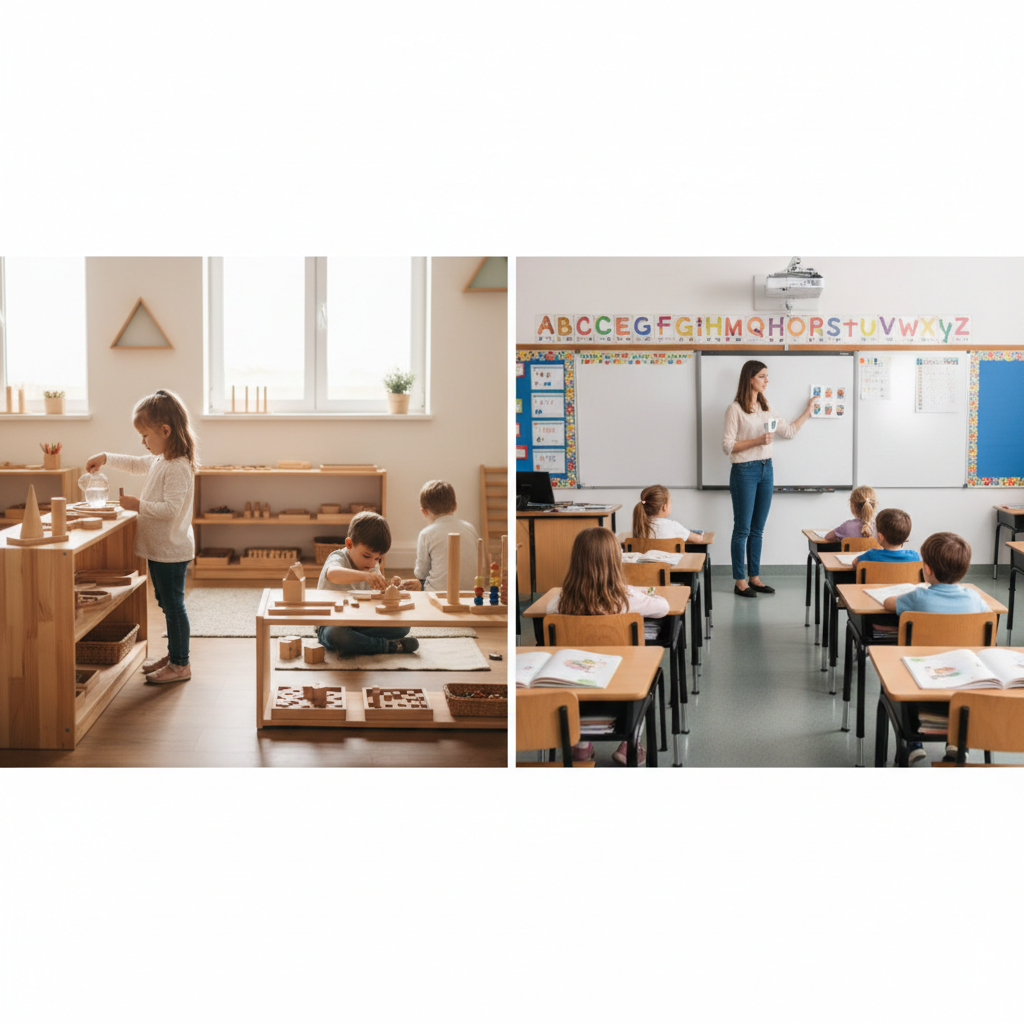
Choosing between Montessori vs traditional education is one of the most significant decisions parents face when their child approaches school age. Both approaches have passionate advocates and decades of research behind them, yet they differ fundamentally in philosophy, classroom structure, and teaching methods. Understanding these differences, backed by evidence rather than ideology, can help you make the choice that best fits your child's unique temperament and your family's values.
Understanding the Montessori Method
Developed by Dr. Maria Montessori in the early 1900s, the Montessori method is built on the principle that children are naturally curious learners who develop best when given freedom within a structured environment. Key characteristics of Montessori education include:
- Mixed-age classrooms: Typically spanning three-year age ranges (3-6, 6-9, 9-12), allowing younger children to learn from older peers and older children to reinforce knowledge through teaching.
- Self-directed learning: Children choose their activities from a carefully prepared environment. Teachers serve as guides rather than lecturers, observing and intervening only when necessary.
- Hands-on materials: Montessori classrooms feature specialized manipulative materials designed to teach concepts through sensory exploration. Math beads, sandpaper letters, and practical life materials are hallmarks of the approach.
- Uninterrupted work periods: Children typically have two- to three-hour blocks of uninterrupted work time, allowing deep concentration and flow states.
- No grades or tests: Progress is assessed through teacher observation and portfolio-based assessment rather than standardized testing.
According to the American Montessori Society, there are over 5,000 Montessori schools in the United States, including approximately 500 public Montessori programs.
Understanding Traditional Education
Traditional education, also called conventional or teacher-directed education, follows a more structured, standardized approach. Key characteristics include:
- Same-age classrooms: Students are grouped by age, progressing through grade levels together.
- Teacher-directed instruction: The teacher leads lessons, sets the pace, and determines the curriculum sequence for the entire class.
- Standardized curriculum: Learning objectives and materials are predetermined and typically aligned with state or national standards.
- Structured schedule: The day is divided into subject-specific periods, with transitions between activities.
- Grades and assessments: Student progress is measured through tests, quizzes, report cards, and increasingly, standardized assessments.
What the Research Says: Academic Outcomes
A landmark longitudinal study published in Frontiers in Psychology (2024) tracked over 3,000 children from preschool through eighth grade and found several notable differences:
- Reading and math: Montessori students showed accelerated growth in reading and math during the preschool and early elementary years. By fifth grade, the academic differences between the two groups narrowed, with both achieving comparable standardized test scores.
- Executive function: Montessori students consistently demonstrated stronger executive function skills, including working memory, cognitive flexibility, and inhibitory control. Dr. Angeline Lillard of the University of Virginia, who has published extensively on Montessori outcomes, attributes this to the self-regulation demanded by the Montessori environment.
- Creativity: A 2025 study in the Journal of Creative Behavior found that Montessori students scored 15% higher on divergent thinking assessments compared to traditionally educated peers. Researchers attributed this to the open-ended nature of Montessori activities.
However, the research comes with important caveats. Dr. Lillard notes that outcomes vary significantly based on the fidelity of Montessori implementation. Schools that label themselves Montessori but do not adhere closely to the method's principles may not produce the same results. The term "Montessori" is not trademarked, so quality varies widely.
Social and Emotional Development
Social development is where the two approaches may diverge most clearly. A 2024 meta-analysis in Child Development examined 47 studies and found:
- Conflict resolution: Montessori students demonstrated stronger conflict resolution skills, attributed to the mixed-age classroom where older children model prosocial behavior and younger children practice social navigation.
- Collaboration: Both models produced comparable levels of collaborative skills, though the nature of collaboration differed. Montessori children more often chose to collaborate, while traditional school children collaborated when directed to do so.
- Social conformity: Traditional education students showed stronger adherence to group norms and teacher expectations. Depending on perspective, this can be viewed as either positive social skill development or excessive compliance.
- Intrinsic motivation: Multiple studies have found that Montessori students report higher levels of intrinsic motivation and enjoyment of learning. A 2025 survey by the National Center for Education Statistics found that Montessori students were 22% more likely to describe themselves as "loving school" compared to traditionally educated peers.
Practical Considerations for Parents
Beyond philosophy and research, several practical factors should influence your decision:
- Cost: Private Montessori preschools typically cost between $10,000 and $25,000 per year in the United States, though public Montessori options are growing. Traditional public school is free, while private traditional schools range from $5,000 to $40,000+ depending on location.
- Availability: Traditional schools are available everywhere. Quality Montessori programs may not be accessible in all areas, particularly in rural communities.
- Your child's temperament: Children who are naturally self-directed, curious, and comfortable with open-ended activities often thrive in Montessori. Children who prefer clear structure, direct instruction, and regular feedback may feel more comfortable in traditional settings. Dr. Steven Hughes, a pediatric neuropsychologist, emphasizes that "there is no one-size-fits-all answer. The best education is the one that meets your individual child where they are."
- Transition considerations: Children who spend their early years in Montessori and then transition to traditional school may face an adjustment period. The shift from self-directed to teacher-directed learning can be challenging for some students.
- Parent involvement: Montessori programs often require greater parent involvement and alignment with Montessori principles at home. If the home environment contradicts the school environment, the effectiveness of either approach diminishes.
The Hybrid Approach: Blending the Best of Both
An increasingly popular option is blending Montessori principles with elements of traditional education. Many progressive traditional schools have adopted Montessori-inspired practices, including hands-on learning, student choice, and project-based learning. At home, you can incorporate Montessori principles regardless of your child's school type:
- Create a prepared environment with accessible, organized materials
- Allow children to make age-appropriate choices throughout the day
- Encourage independence in practical life skills like dressing, cooking, and cleaning
- Follow your child's interests and provide resources to explore them deeply
- Limit interruptions during focused play and allow children to complete activities at their own pace
Ultimately, the choice between Montessori and traditional education is not about which method is objectively superior. Both can produce excellent outcomes when implemented well. The decision should be based on your child's individual needs, your family's values, the quality of the specific programs available to you, and the practical realities of cost and location. Visit schools, observe classrooms, talk to teachers and other parents, and trust your knowledge of your own child. The best educational choice is the one that makes your child excited to learn every day.
Written by
You might also like
 81
81
Best Creative Craft Kits for Kids: Art Projects They'll Actually Finish
Discover the best creative craft kits for kids that they will actually finish. From sculpting and glass painti...
Our Favorite Ways to Bring Love, Peace, and Whimsy Into Your Child's World
From imaginative play sets to calming mindfulness tools, these are our favorite picks that bring love, peace,...
Our Favorite Bring Your Love, Peace, and Whimsy! Toys and Gifts for Kids
Discover 8 whimsical toys and gifts that bring love, peace, and creative wonder into your child's world while...