The Science Behind Play-Based Learning: Why Playing Is Your Child's Most Important Work
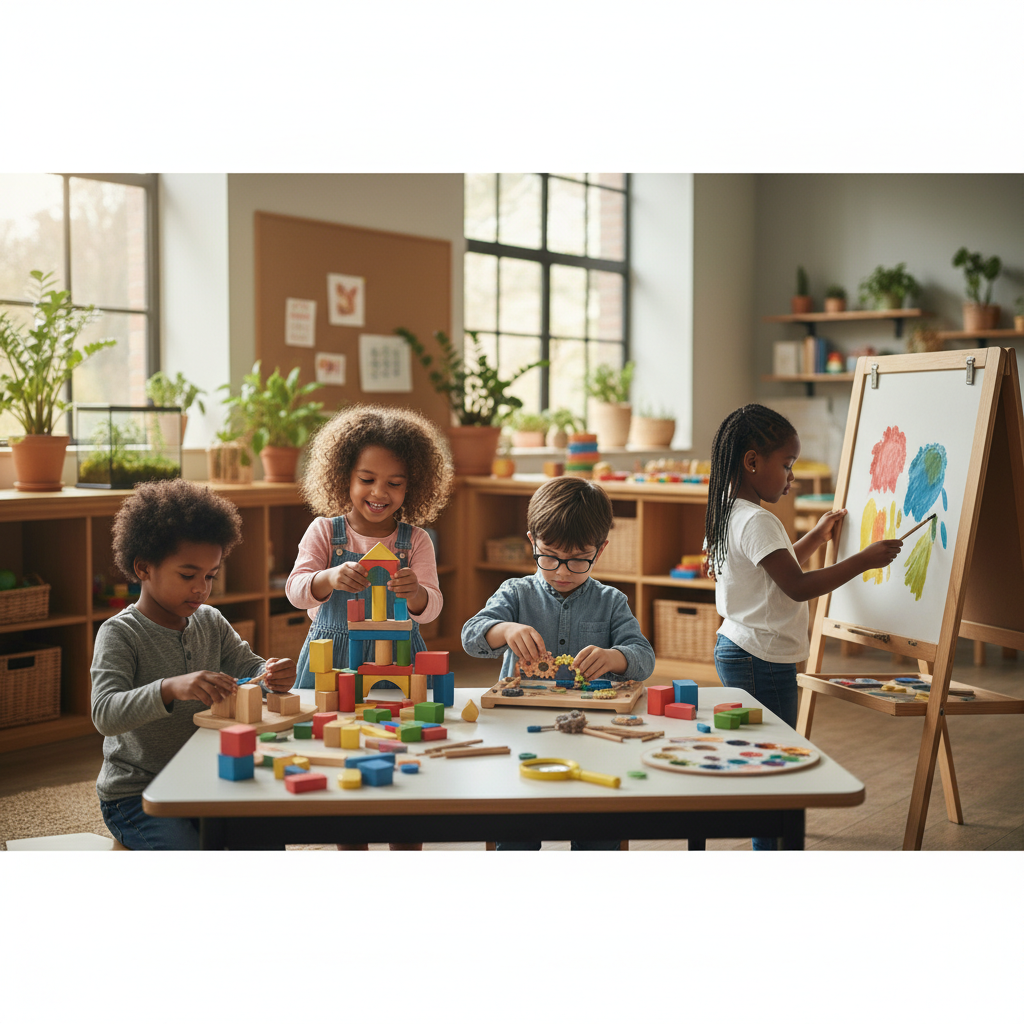
In a culture that increasingly values academic achievement from ever-younger ages, a growing body of scientific evidence delivers a counter-intuitive message: the most effective way for young children to learn is through play-based learning. This is not wishful thinking from parents who want to let their kids run free. It is the conclusion of decades of research in developmental psychology, neuroscience, and education, endorsed by organizations ranging from the American Academy of Pediatrics to the United Nations. Play is not the opposite of learning. Play is how learning happens.
What Is Play-Based Learning?
Play-based learning is an educational approach in which children learn through self-directed, hands-on play experiences. It can be entirely child-initiated (free play) or gently guided by an adult toward specific learning objectives (guided play). The key distinction from traditional instruction is that the child is an active agent in the learning process, driven by intrinsic motivation and curiosity rather than external direction.
Dr. Peter Gray, a research professor of psychology at Boston College and author of Free to Learn, defines play by five essential characteristics: it is self-chosen and self-directed, it is intrinsically motivated, it is guided by mental rules that the player creates, it involves imagination, and it is conducted in an active, alert but non-stressed frame of mind. When all five elements are present, the brain enters an optimal state for learning.
The distinction between free play and guided play is important. Research by Drs. Kathy Hirsh-Pasek and Roberta Michnick Golinkoff, published in their book Becoming Brilliant, shows that guided play, where an adult sets up the environment and gently scaffolds learning while allowing the child to lead, often produces the strongest learning outcomes. This differs from both completely unstructured free play and from adult-directed instruction.
The Neuroscience of Play
When children play, their brains are performing at peak capacity. Neuroscientific research has revealed several mechanisms by which play promotes brain development:
- Prefrontal cortex development: Play, particularly imaginative and social play, activates and strengthens the prefrontal cortex, the brain region responsible for planning, decision-making, impulse control, and social behavior. A 2024 study using functional MRI at the University of Cambridge found that children engaged in pretend play showed prefrontal cortex activation patterns similar to those seen in adults solving complex problems.
- Synaptic pruning and strengthening: During play, the brain forms new neural connections and strengthens frequently used pathways. Dr. Jaak Panksepp, a neuroscientist who spent decades studying play in mammals, demonstrated that play activates brain-derived neurotrophic factor (BDNF) in the prefrontal cortex, a protein essential for neural growth and plasticity.
- Stress regulation: Play triggers the release of endorphins and reduces cortisol levels. According to the National Institute for Play, children who engage in regular play show more adaptive stress responses, with lower baseline cortisol and faster recovery from stressful events. This matters because chronic stress impairs learning and memory.
- Dopamine and motivation: Play naturally activates the brain's reward system, releasing dopamine, which enhances attention, motivation, and memory consolidation. This is why children can play for hours without losing focus but struggle to sit through twenty minutes of direct instruction.
What the Research Shows: Academic Outcomes
One of the most common concerns about play-based learning is whether it adequately prepares children for academic demands. The evidence overwhelmingly shows that it does, and often better than early academic instruction.
A landmark 2024 study published in the Journal of Educational Psychology compared outcomes for over 5,000 children in play-based versus academic-focused preschool programs across six countries. The findings were striking:
- By the end of kindergarten, children from play-based programs scored equivalently on reading and math assessments compared to children from academic-focused programs.
- By second grade, play-based children had surpassed their academically instructed peers in reading, math, and science.
- By fourth grade, play-based children showed significantly stronger motivation, creativity, and self-regulation, along with maintained academic advantages.
- The academically instructed group showed higher rates of school anxiety and lower rates of academic enjoyment.
Similar findings emerged from a 2025 longitudinal study of Finnish education, where formal academic instruction does not begin until age seven and the early years are dominated by play. Finnish students consistently rank among the top performers in international academic assessments, leading researchers to describe their system as evidence that "more play and less early instruction produces better long-term academic outcomes."
Types of Play and Their Specific Benefits
Different types of play develop different competencies. Understanding these can help parents provide a balanced play diet:
Pretend Play (Imaginative/Dramatic Play)
When children pretend to be doctors, teachers, firefighters, or superheroes, they are developing what psychologists call "theory of mind," the ability to understand that other people have thoughts, feelings, and perspectives different from their own. A 2024 study by Dr. Angeline Lillard at the University of Virginia found that children who engaged in more pretend play showed stronger theory of mind development, better emotional regulation, and superior narrative skills. Dr. Lillard notes: "When a child pretends to be a baby while playing house, they must inhibit their own knowledge and behavior to adopt a different perspective. This is cognitively demanding and profoundly developmental."
Constructive Play (Building and Creating)
Block building, LEGOs, sand construction, and art creation develop spatial reasoning, planning, problem-solving, and fine motor skills. A 2025 study published in Child Development found that the complexity of children's block play at age four was a significant predictor of mathematical achievement in seventh grade, even after controlling for IQ and socioeconomic status. Researchers attributed this to the spatial-mathematical thinking that construction naturally requires.
Physical Play (Rough-and-Tumble, Outdoor, Active Play)
Physical play is not just exercise. Dr. Stuart Brown, founder of the National Institute for Play, argues that rough-and-tumble play teaches children to read social cues, negotiate boundaries, and regulate aggression. A 2024 meta-analysis in Pediatrics found that children who engaged in at least 60 minutes of active play daily showed 25% better attention and executive function in classroom settings. Outdoor play adds the additional benefits of nature exposure, which a 2025 Stanford study linked to reduced ADHD symptoms, improved mood, and enhanced creativity.
Games with Rules
Board games, card games, and organized playground games teach turn-taking, following rules, strategic thinking, and gracious winning and losing. A 2024 study in Early Childhood Education Journal found that regular board game play improved mathematical skills in preschoolers more effectively than direct math instruction of the same duration. Games like Chutes and Ladders teach counting and number recognition, while games like Guess Who develop logical deduction.
How to Optimize Play for Learning at Home
Parents play a crucial role in creating environments that maximize the learning potential of play. Here are evidence-based strategies:
- Protect unstructured playtime: Resist the urge to schedule every minute. The American Academy of Pediatrics recommends that children have at least one hour of unstructured free play per day. This time should be genuinely free, with no adult agenda or predetermined outcomes.
- Provide open-ended materials: Blocks, art supplies, sand, water, fabric scraps, cardboard boxes, and natural materials like sticks and stones support more creative and sustained play than single-purpose toys. Research by Dr. Kathy Sylva at the University of Oxford found that children played more creatively and for longer durations with open-ended materials compared to electronic or single-function toys.
- Use guided play strategically: When you want to target specific learning, set up the environment and pose questions, then step back. For example, to promote math learning, you might set out measuring cups and ask "I wonder how many small cups fill up the big cup?" then let your child explore. This is more effective than directing the activity step by step.
- Join the play, but let children lead: When you play with your child, follow their lead rather than directing. Let them assign roles, set rules, and determine the narrative. Your participation provides social scaffolding and vocabulary, while their leadership develops agency and creativity.
- Reduce screen-based play: While some educational apps have value, screen-based play is consistently less effective for learning than physical play. The three-dimensional, multi-sensory, social nature of real-world play engages the brain in ways that screens cannot replicate. Dr. Dimitri Christakis of Seattle Children's Hospital recommends that for every hour of screen time, children should have at least two hours of hands-on play.
- Create a play-friendly home: Designate spaces where mess is acceptable. Rotate toys to maintain novelty. Keep play materials accessible at child height. Accept that valuable play is often noisy and messy.
The science is clear: play is not a break from learning. Play is the vehicle through which young children learn best. It develops the cognitive, social, emotional, and physical foundations that support all future academic and life success. In a world that increasingly pressures children to grow up fast and achieve early, the most radical and evidence-based thing parents can do is protect their children's right to play. Let them build, imagine, explore, and create. Their brains will thank you for it, not just now, but for decades to come.
Written by
You might also like
 81
81
Best Creative Craft Kits for Kids: Art Projects They'll Actually Finish
Discover the best creative craft kits for kids that they will actually finish. From sculpting and glass painti...
Our Favorite Ways to Bring Love, Peace, and Whimsy Into Your Child's World
From imaginative play sets to calming mindfulness tools, these are our favorite picks that bring love, peace,...
Our Favorite Bring Your Love, Peace, and Whimsy! Toys and Gifts for Kids
Discover 8 whimsical toys and gifts that bring love, peace, and creative wonder into your child's world while...